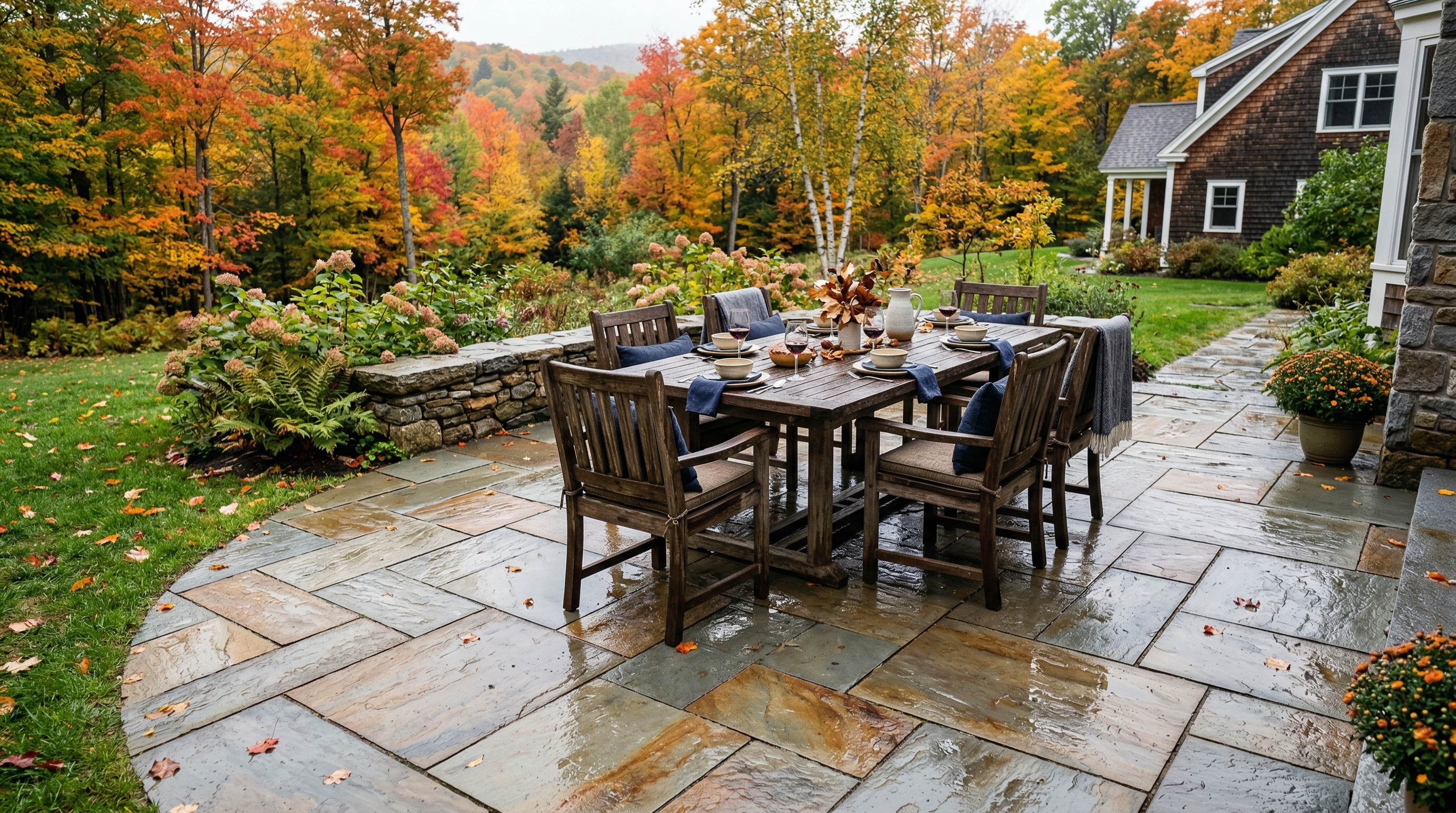
A few years back we got called out to a patio in Mendon that was three years old and already falling apart. Concrete pavers shifting, corners chipping, whole sections heaving up two inches above their neighbors. The homeowner said they'd paid good money for a "professional" install. Turned out the base was four inches of crushed stone on top of clay with no compaction and no edge restraint. The material didn't fail. The install failed.
That's the first thing to understand about the bluestone vs. concrete debate: the material matters less than the base underneath it. But once you get the base right, and we'll talk about that, there are real differences between these two that matter in Vermont.
How Does the Vermont Freeze-Thaw Cycle Affect Pavers?
Rutland County sees somewhere around 100 freeze-thaw cycles per year. That's 100 times moisture in the ground expands as it freezes and contracts as it thaws. Any paving material has to survive that without cracking, spalling, or shifting.
Bluestone is natural stone: dense, low porosity, and it handles freeze-thaw beautifully. It doesn't absorb much water, so there's less expansion happening inside the stone itself. We've pulled up 20-year-old bluestone patios that look almost the same as when they were laid. The surface develops a patina over time, but the structural integrity stays.
Concrete pavers are manufactured. Quality varies a lot. High-end pavers from Belgard or Unilock with a high PSI rating (8,000+) handle freeze-thaw well. Budget pavers from the big box stores, the ones that run $2-3 per square foot, absorb more water and start flaking within three to five winters. We see it constantly on repair calls.
What Does Each Material Cost Installed?
Here's the honest breakdown for Rutland County pricing as of early 2026:
| Item | Concrete Pavers | Bluestone |
|---|---|---|
| Material per sq ft | $4 - $8 | $8 - $15 |
| Base prep per sq ft | $3 - $5 | $3 - $5 |
| Labor per sq ft | $6 - $10 | $8 - $14 |
| Total installed per sq ft | $13 - $23 | $19 - $34 |
A typical 300-square-foot patio runs $4,000-$7,000 in concrete pavers or $6,000-$10,000 in bluestone. That's a meaningful difference upfront. But here's what most quotes don't tell you: the maintenance and replacement costs over 15-20 years close that gap significantly.
Quick quiz
Bluestone or pavers?
Five taps. We'll tell you which one fits your project and why.
What look are you after?
How are you thinking about cost?
How much upkeep will you put up with?
What is it for?
How long are you staying in the home?
How Do Maintenance Needs Compare?
Concrete pavers need polymeric sand swept into the joints every two to three years. The sand washes out, weeds grow in, ants move in. Sealing helps but adds $1-2 per square foot every three to four years. Some pavers fade, especially reds and browns, and there's no bringing the color back without replacing them.
Bluestone needs almost nothing. We tell our clients to sweep it, hose it down, maybe hit it with a pressure washer every couple years if moss builds up. The color shifts over time from bright blue-gray to a deeper, weathered tone. Most people prefer the aged look. No sealing required unless you want to keep the wet-look appearance.
What Failures Do We See on Repair Jobs?
We do a lot of patio repairs. Here's what we find when we tear things apart:
Concrete paver failures:
- Surface spalling and flaking on cheap pavers (freeze-thaw damage)
- Color fading, especially on tinted pavers
- Edge pieces cracking because no edge restraint was installed
- Settlement from inadequate base: this is the big one
- Polymeric sand failure leading to shifting and weed growth
Bluestone failures:
- Cracking along natural cleavage lines (usually from an uneven base, not the stone itself)
- Lippage (uneven edges where stones meet) if the thickness wasn't calibrated during install
- Mortar joint cracking on wet-laid installations (dry-laid avoids this entirely)
Notice the pattern: most failures trace back to the installation, not the material. A good base is 6-8 inches of compacted processed gravel, topped with an inch of leveling sand, with proper pitch for drainage. Skip any of that and it doesn't matter what you put on top.
Which Does Meticulous Recommend?
Depends on the project. Here's our honest take:
Choose bluestone if:
- You want a patio that'll look better in 10 years than it does today
- You're staying in the home long-term
- You care about a natural, high-end look
- You don't want to think about maintenance
Choose concrete pavers if:
- Budget is the primary driver
- You want a specific pattern or color that stone can't give you
- You're building a driveway (pavers handle vehicle loads better than flagstone)
- You want the option to easily replace individual pieces
For patios and walkways, we install more bluestone than anything else. For driveways and areas with vehicle traffic, we go concrete pavers: specifically Unilock or Belgard products rated for vehicular use.
Either way, we build the same base. Six to eight inches of compacted 3/4-inch processed gravel, one inch of concrete sand for leveling, proper pitch away from the house at a quarter inch per foot minimum. Edge restraint on every job, no exceptions. That's what makes it last, whether you put $5 pavers or $15 bluestone on top.
If you're weighing options for a hardscape project, we're happy to walk your property and give you a straight answer on what makes sense. No pressure, no upsell. We've been doing this long enough that we'd rather steer you right the first time than fix someone else's mistake later.