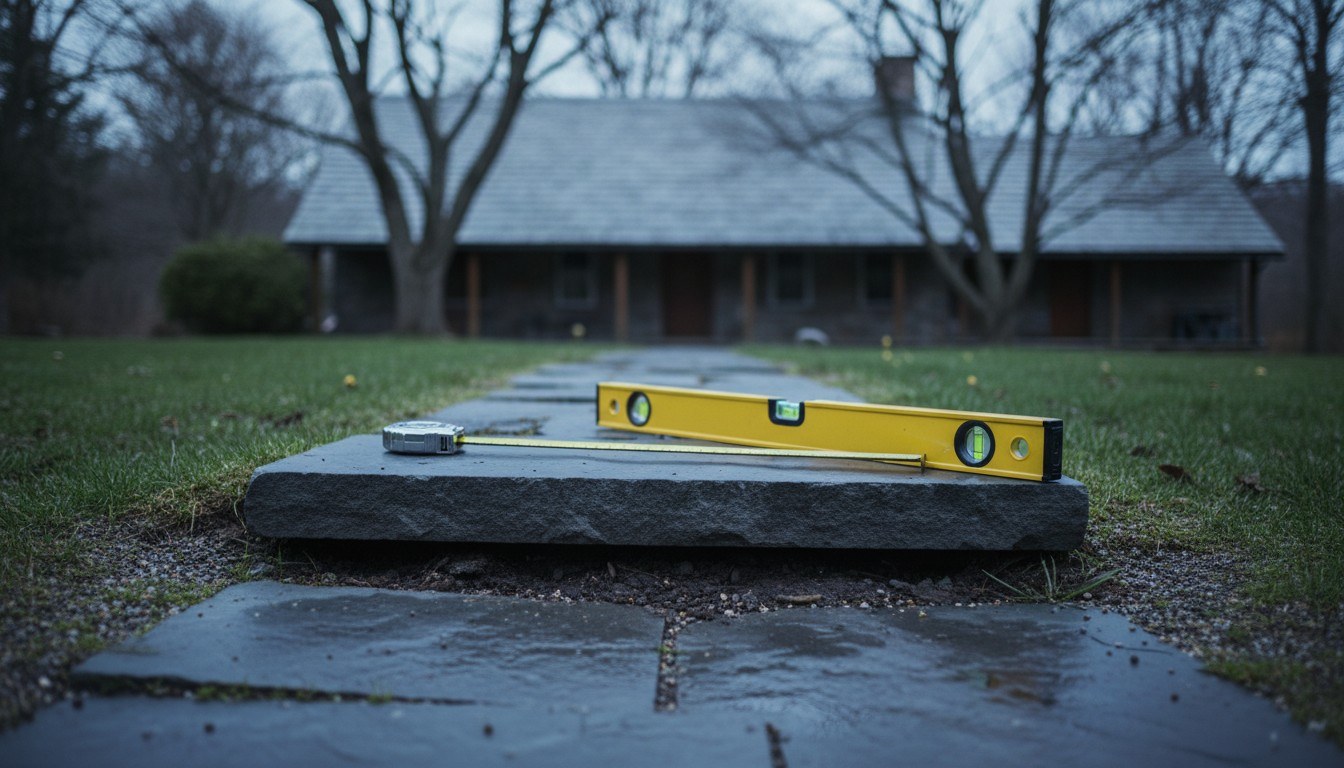
The phone starts ringing in the first week of May. The frost is finally out of the ground in Rutland County, the snowpack is gone, the mud is drying down to a workable surface, and second-home owners in Killington, Pittsfield, Mendon, Woodstock, and Chittenden are walking their properties for the first time since November. What they see is rarely pretty. Bluestone walkway stones tipped two inches above their neighbors. Brick patio sections heaved into a wave. Paver edges sunk where the base failed. Concrete slabs cracked across the joint that did not exist last fall. Frost heave is the price of doing business on hardscape in Vermont, and the question is never whether it will happen but how badly it happened this winter and how much of it has to be redone before Memorial Day.
This is the post we wish every Rutland County homeowner read in early May. The information applies whether you hire Meticulous or another property manager. The point is to know what frost heave actually does, how to diagnose what level of repair the failure needs, and what the honest pricing looks like in this market.
What Frost Heave Actually Does to Vermont Hardscape
Frost heave is what happens when water in the soil under a walkway, patio, or driveway freezes, expands, and lifts whatever is sitting on top of it. The mechanism is simple but the variations are not. Three different kinds of failure show up on Rutland County properties every spring:
- Uniform lift across an entire section. The whole walkway rises three or four inches over the winter. When the frost releases, the walkway settles back down, sometimes to where it started, sometimes not. If the soil compacted underneath, the walkway sits low. If a freeze cycle in March refroze a partially thawed base, sections lock in at the lifted height.
- Differential lift. The bad one. One side of the walkway lifts more than the other because the soil composition, drainage, or sun exposure is different across the surface. The walkway ends up tipped or twisted, with individual stones popping above their neighbors. This is the failure mode we see most often on shore-area homes built before 2000, where the original base was four inches of crushed run on undisturbed clay subsoil.
- Frost wedging at the edges. Water gets between stones or under the perimeter, freezes, and pries the hardscape apart from the edge inward. Pavers lose their interlock. Bluestone joints open up. Brick edges separate from the soldier course. The middle of the surface looks fine; the edges have failed.
Vermont's freeze depth in Rutland County runs 48 to 60 inches in a normal winter, deeper in cold snaps. Anything not founded below the frost line is going to move, full stop. The question is whether the design allowed for the movement (gravel base over geotextile, flexible jointing) or fought it (rigid mortar set, undersized base, no drainage). The properties we walk in early May where everything still looks fine are the ones where the original install was done right. The ones we get called to fix were usually built fast and cheap.
How to Diagnose Frost Heave Damage on Your Walkway or Patio
A real assessment in May involves walking the hardscape with a long straightedge and a pair of eyes, not just looking from the porch. Things we check, in order:
- Lippage between stones or pavers. Any tile or stone sitting more than 1/8 inch above its neighbor is a tripping hazard and indicates the base under that stone has moved. We mark every one with chalk so we can count them.
- Slope and pitch. A walkway should pitch slightly away from the house, typically 1/4 inch per foot. We use a 4-foot level to check pitch. If a section pitches toward the house, water is now running toward the foundation, which is a separate and bigger problem.
- Edge integrity. The perimeter of any hardscape surface is where frost wedging starts. We look for separated joints, soldier courses pulling away from the field, and edging that has tipped outward.
- Joint condition. Polymeric sand washed out over the winter. Mortar joints cracked. Polysand joints opened to 1/2 inch wide. These are signs the surface is no longer locked together and will continue to deteriorate.
- Sub-base voids. We tap suspect sections with a rubber mallet. A solid section sounds dense; a section with a void underneath sounds hollow. Voids mean the base settled and the surface is unsupported.
- Drainage evidence. Standing water trails in the lawn next to the hardscape. Mud lines on the stone where water has been pooling. Algae growth on shaded sections that did not have algae last year. All signs that water is sitting where it should not.
- Cracking patterns on concrete. Straight cracks across a slab usually mean settlement. Map cracking across the surface usually means freeze-thaw degradation of the concrete itself. Different problems, different fixes.
A full assessment on a typical residential walkway and patio takes us 30 to 45 minutes. We document with photos and a marked-up site plan so the homeowner can see exactly what we are seeing. The cheap version of this assessment is a contractor walking the property in five minutes and quoting a number. That quote is a guess.
Lift-and-Reset vs. Full Rebuild: Which One Does the Failure Need?
The two repair strategies for frost-heaved hardscape are dramatically different in scope and cost. Picking the wrong one wastes money. The right call depends on what failed.
| Failure | Right repair | Why |
|---|---|---|
| 1 to 6 stones lifted, sound base elsewhere | Lift and reset | Localized failure. Pull the affected stones, fix the base under them, reset to grade. |
| Whole section tipped, base mostly intact | Lift and reset the section | Larger but same approach. Document course pattern before lifting. |
| Edges blown out, field intact | Edge restoration only | Reset edge course, install new edge restraint, refill joints. |
| Joints washed out, no lippage | Joint refresh | Sweep out failed sand, install fresh polymeric sand, activate with water. |
| Multiple zones of differential lift | Full rebuild | Base failure is widespread. Lift and reset is throwing good money after bad. |
| Sub-base voids confirmed across the surface | Full rebuild | The base no longer supports the surface. Reset is temporary at best. |
| Concrete with structural cracks across joints | Replace | Concrete repair on Vermont frost-line failures is rarely durable. Replace with proper base. |
| Concrete with surface map cracking only | Resurface or accept | Cosmetic, not structural. Resurfacing is an option; replacement is rarely worth it. |
The dishonest version of this is a contractor who quotes "lift and reset" on a hardscape that needs a full rebuild because the smaller quote wins the job. The homeowner pays for the reset, the same failures show up next spring, and now they pay again. We have repaired enough of these to be confident that the right call in May is the call the surface actually needs, not the call that fits a budget.
What Lift-and-Reset Actually Involves
The proper process for a real lift-and-reset on a Vermont walkway or patio:
- Photograph the section in current condition. Reference for course pattern, joint widths, and edge alignment.
- Mark each stone or paver with chalk. Course position and orientation. The same stone has to go back in the same place facing the same way, or the pattern is wrong.
- Lift the surface carefully. Bluestone and natural stone get pried with a flat bar. Pavers get lifted with extraction tongs to avoid edge damage. Each piece goes onto pallet boards adjacent to the work area.
- Excavate the failed base. Remove the original setting bed and any compromised crushed stone underneath. Check that the deeper base is sound; if not, extend the excavation.
- Diagnose drainage if present. Standing water under the surface is information. If a low spot is holding water, the base will fail again. Address the drainage before any new material goes in.
- Install fresh setting bed. Typically 1 inch of clean stone dust or coarse sand, screeded flat to spec. Some installs use a slightly different mix; the spec depends on the surface type.
- Reset stones to grade. Reverse the chalk mark order. Check level and pitch as you go with a long straightedge.
- Install joint material. Polymeric sand for paver and most stone joints. The polymeric stabilizer locks the joints once water-activated.
- Activate joints with water. Light mist, multiple passes, on a dry day. Check that the polysand sets up properly.
- Re-edge if needed. Existing edge restraint may be damaged from the original lift. Replace with rigid plastic edge or aluminum edging depending on the design.
The work is straightforward but unforgiving on shortcuts. The most common mistake we see is contractors skipping the chalk-mark step, lifting a section, and trying to reset it from memory. The pattern always ends up off, and the homeowner notices.
What Frost Heave Repair Costs in Rutland County
The honest numbers for typical Rutland County hardscape repair, based on what we and other reputable property managers in the area charge in 2026:
- Localized lift-and-reset (1 to 10 stones or pavers): $400 to $900. Half-day job with a two-person crew. Polymeric sand and replacement materials included.
- Section lift-and-reset (20 to 80 square feet): $1,200 to $3,000. Full-day job. May include base material refresh and partial edging replacement.
- Edge restoration on a full walkway or patio: $600 to $1,400. Reset perimeter course, install new edge restraint, joint refresh.
- Polymeric sand joint refresh on full surface: $0.75 to $1.50 per square foot of surface. Includes sweeping out old material, installing new, water activation.
- Full rebuild of a typical 120 square foot walkway: $5,500 to $9,000 depending on materials and excavation depth. Includes full excavation to undisturbed subsoil, geotextile, 8 inches of crushed run base, setting bed, surface material, and edging.
- Full patio rebuild (300 to 500 square feet): $14,000 to $28,000. Material costs dominate. Bluestone is more expensive than concrete pavers; flagstone with mortar joints is more expensive than dry-laid pavers.
- Concrete slab replacement: Variable, typically $14 to $22 per square foot installed. Often includes removal of the failed slab and disposal.
These are 2026 numbers in Rutland County and the surrounding towns. They will vary with the season (May is the busiest month for this work and rates rise accordingly), the access to the work area, and the disposal logistics. The cheap quotes that come in below the bottom of these ranges are almost always missing something in scope. Verify what they include before signing.
What You Can Do Yourself, and What You Cannot
Some frost heave repair is in reach for a homeowner with a strong back and basic tools. Most is not. Honest categories:
Reasonable DIY: Sweeping out old joint sand and re-applying polymeric sand on a small patio. Resetting one or two loose flagstones in a garden path with a quick excavation and setting bed. Stabilizing a loose edging restraint with new spikes.
Not reasonable DIY: Lift-and-reset on a structural walkway, especially one in front of an entry where lippage is a fall liability. Diagnosis of base failure (you will guess wrong). Polymeric sand on a wet day (it will set wrong). Concrete crack injection (the product is unforgiving and the cost of failure is the slab). Drainage modifications where the work has to grade away from a foundation.
If the walkway is in front of an entry, the patio is host to a family gathering this summer, or the surface is more than 100 square feet, hire the work. The math on DIY rarely works once a homeowner factors in the time, equipment rental, and the rate of failed first attempts.
Why May Is the Window for This Work
Three reasons May is the right time to address frost heave repair in Rutland County:
- The damage is visible. By the second week of May the frost is out, the ground is workable, and every failure is documented by the season. Waiting until July means working around lawns that are now growing, gardens that are planted, and outdoor furniture that is in place.
- The schedule is open. Most local hardscape and property crews are not yet booked solid for the season. Calling in early May gets us on site within a week. Calling in late June means scheduling for August.
- The summer use window is intact. A walkway repaired in May is fully cured and usable for the entire summer season. A walkway repaired in October is cured for one month before the freeze cycle starts again.
The single best argument for May repair is the one we hear from homeowners after the fact: they wish they had called in early May instead of waiting until the July party. By July the repair has to be done in a rush, the polymeric sand is competing with humidity, and the schedule for the project keeps slipping.
How Meticulous Handles Frost Heave Repair
We work on hardscape repair across Killington, Rutland, Mendon, Pittsfield, Chittenden, Woodstock, Ludlow, Proctor, West Rutland, Brandon, and Castleton. The process is the assessment described above (45 minutes on site, marked-up photos), a written quote with itemized scope, and scheduled execution typically within seven to fourteen days of approval. For second-home owners, we manage the work without requiring you on site and send before-and-after photos.
If your walkway, patio, or hardscape has surfaced from winter looking rougher than you remembered, reach out for a May assessment. We will tell you honestly whether the surface needs a lift-and-reset, a full rebuild, or whether it is fine and can ride another season.