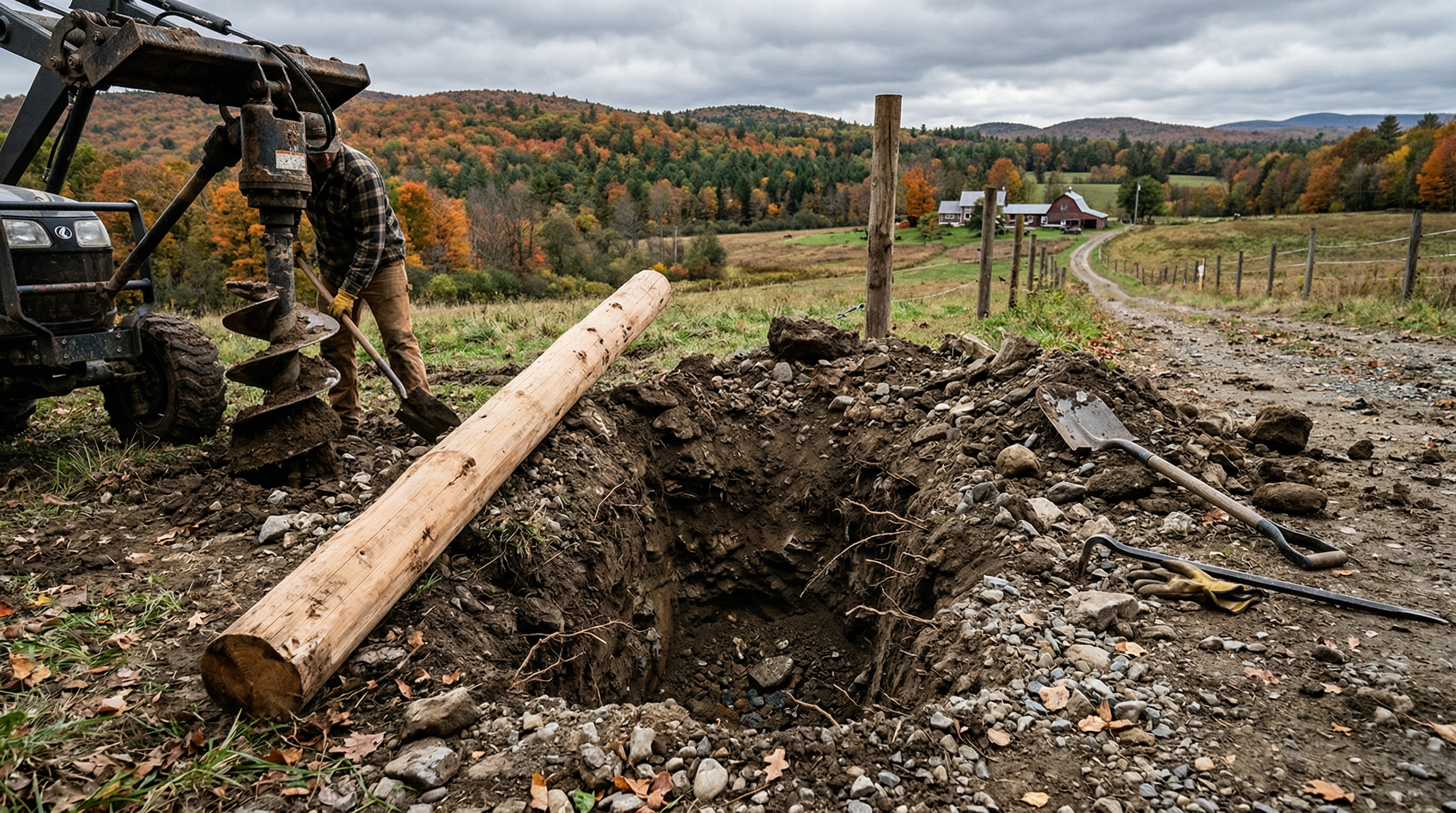
Yes, fence posts need to be set below the frost line, and in Vermont that is deeper than most people think: the frost line sits at 48 inches in most of Rutland County and pushes to 54–60 inches at higher elevations like Killington, Mendon, and Shrewsbury. A post that stops short of it will heave. Here is what that looks like in practice.
Got a call in March from a homeowner in Killington whose fence looked like a row of crooked teeth. Every third post was tilted at a different angle. The fence was two years old. When we dug up the first post, the concrete footing was sitting at 24 inches. Twenty-four inches, in Killington. The frost line up there is a solid 48 inches, sometimes deeper. That fence never had a chance.
Frost line depth is the single most important factor in whether a Vermont fence stays straight. Get it wrong and physics will tear your fence apart: slowly, silently, every freeze-thaw cycle.
What Is the Frost Line in Vermont?
The frost line is the maximum depth at which ground moisture freezes in winter. Below that line, the soil temperature stays above 32 degrees year-round. In most of Rutland County, the frost line sits at 48 inches. Higher elevations (Killington, Mendon, Shrewsbury) can push to 54 or even 60 inches in exposed areas.
Vermont building code follows the International Building Code, which sets the frost depth for our region at 48 inches. That's the minimum. We treat it as a starting point, not a target.
What Happens When Posts Aren't Deep Enough?
Here's the physics in plain English: water in the soil freezes and expands. That expansion pushes everything upward: rocks, roots, and fence posts. This is frost heave. A post set at 24 inches is sitting entirely within the freeze zone. As the ground freezes from the top down, ice grips the post and the concrete footing and lifts the whole thing. When it thaws, the post doesn't drop back to where it started. Dirt fills the gap underneath. Next freeze, it heaves a little higher.
Over two or three winters, a shallow post can rise 3-6 inches out of the ground. The fence leans. Gates stop closing. Panels pop out. What started as a depth shortcut becomes a full fence replacement.
We've pulled posts that were set at 30, 36 inches and watched the concrete footings come out of the ground like they were planted yesterday. The soil didn't even grip them.
How Deep Does Meticulous Actually Dig?
We dig to 52-54 inches for standard fence posts in the Rutland valley floor. For higher elevations (anything above 1,500 feet) we go 56-60 inches. That gives us a solid 4-6 inches below the frost line, which is where you need to be.
The bottom of the post or the bottom of the concrete footing needs to be below the frost line. Not the top of the concrete, not the middle: the very bottom. If your frost line is 48 inches and your concrete footing is 8 inches tall, the bottom of that hole needs to be at least 56 inches. A lot of installers get this math wrong.
Post depth tool
How deep should your fence posts go?
Three taps. We'll give you the hole depth we'd dig and why.
Where is the fence going?
How tall is the fence?
What's the ground like?
We use a gas-powered two-man auger for most jobs. In rocky Vermont soil, which is most Vermont soil, we sometimes switch to a mini excavator with a rock auger attachment. Hitting ledge at 30 inches is a real possibility in parts of Rutland County. When that happens, we drill through it or pin to it with rebar epoxied into the rock. We don't just stop short and hope for the best.
Concrete or Gravel Backfill: Which Is Better?
This is the great fence post debate, and we've tried both extensively over 15 years.
Concrete is the industry standard. Mix it in the hole around the post, let it set, move on. The upside is rigidity. That post isn't going anywhere laterally. The downside: concrete creates a smooth surface that frost can grip and lift. If the bottom of that concrete plug isn't below the frost line, frost heave will pull the whole unit up like a cork.
Gravel backfill (3/4-inch crushed stone) takes a different approach. You pack the gravel in tight around the post. Gravel drains water away from the post, reducing the moisture available for frost heave. It also doesn't give frost anything smooth to grip: the irregular surfaces let the ground move without taking the post with it. The wood lasts longer too, because it's not sitting in a concrete bathtub holding moisture.
Here's what we do: gravel at the bottom, concrete at the top. We put 6 inches of crushed gravel at the base of the hole for drainage, set the post, pack gravel up to about 12 inches from grade, then pour concrete for the top section. The concrete gives lateral rigidity at the surface where it matters. The gravel at the bottom handles drainage and reduces frost grip on the footing. Best of both worlds.
How Can You Tell if a Fence Was Set Too Shallow?
Walk your fence line in early spring, right after the ground thaws. Look for:
- Posts that are visibly higher than they were in fall: measure from the bottom rail to the ground if you want to track it
- Concrete collars visible at ground level: if you can see the concrete around the base of the post, it's been pushed up
- Leaning posts that were straight when installed: frost heave rarely lifts evenly
- Gates that no longer latch: one post heaved a half inch and now the gate drags or won't close
- Cracked concrete at the base: frost pressure can fracture the footing, and once it's cracked, it's compromised
If you're seeing any of these on a fence that's less than five years old, the posts almost certainly aren't deep enough. It doesn't fix itself. Each winter makes it worse.
We fix a lot of other people's fences. The most common cause of failure, by far, is shallow posts. Digging to 52 inches instead of 36 inches adds maybe 15 minutes per hole and costs almost nothing extra in materials. But it's the difference between a fence that stands straight for 20 years and one that's falling apart in three.
If your fence is showing signs of heave, or you're planning a new fence and want it done right the first time, give us a call. We've been setting posts in Rutland County soil since 2009, and we know where the rocks are. Fence posts are part of our carpentry and construction work, alongside decks and exterior repairs. For the full rundown on post depth, size, spacing, and which wood lasts in Vermont ground, read our guide to how deep to set fence posts and the frost-line rule. For the price side of the decision, see our breakdown of what a fence costs in Vermont by material, length, and terrain.