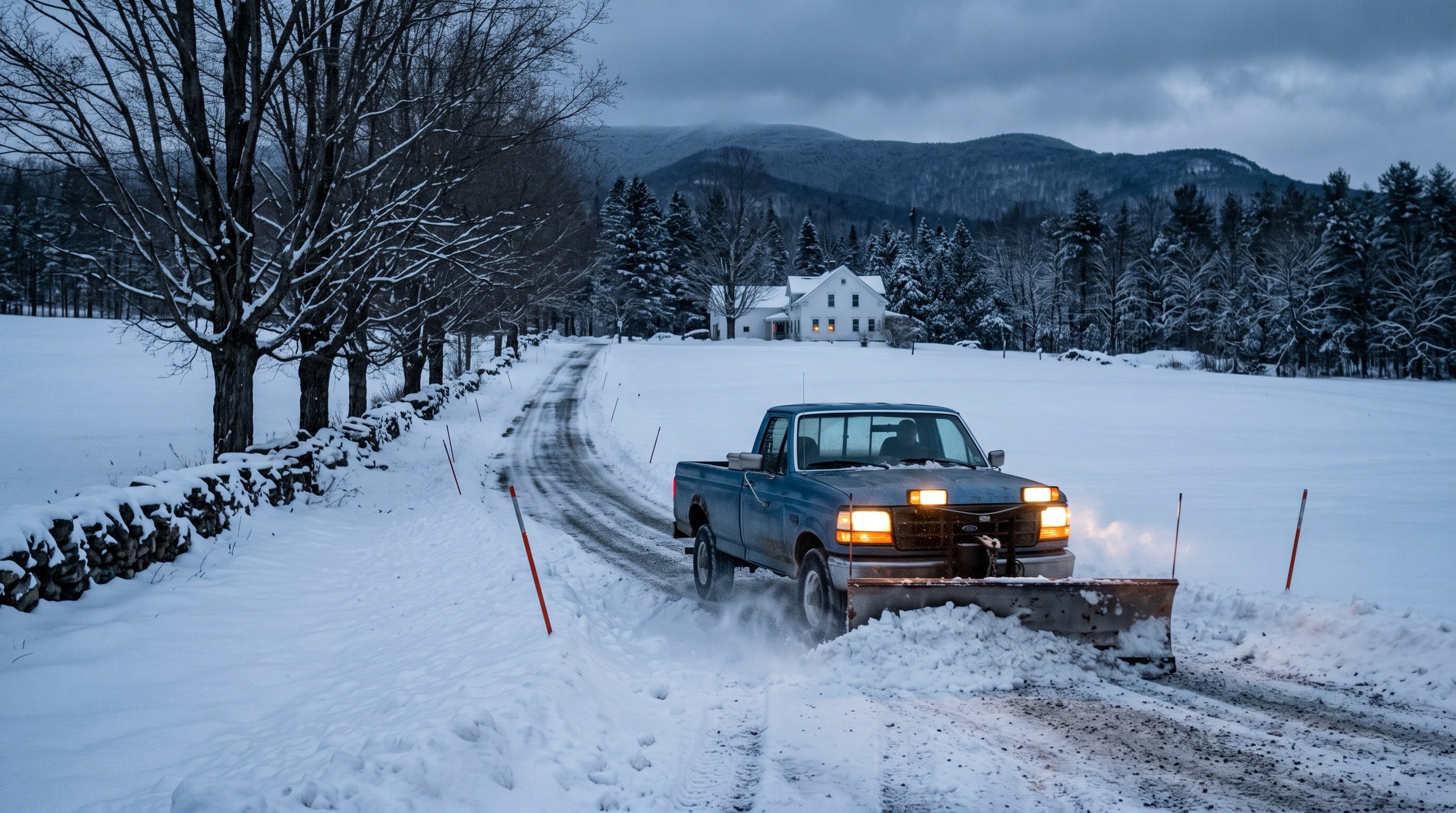
A seasonal snow price is a bet on a normal winter at your address. Whoever wrote the quote pictured a certain number of storms and a certain total snowfall, spread the cost of that winter across your installments, and then decided who pays when the real winter doesn't match. In the Rutland valley a normal season runs somewhere around 60 to 80 inches, spread over anything from a dozen to twenty five plowable events. Every seasonal contract is built on an assumption like that, whether or not anyone wrote it down. What you want to know before you sign is what happens on the far side of it.
We sell both seasonal and per storm, and we've already written up which one suits which property. This is the narrower question people bring us once they've settled on seasonal and are holding two quotes that don't look alike. What is this number assuming, and what does it do when the winter disagrees?
Three ways a contract handles a heavy winter
Find the line in the agreement that covers a winter bigger than expected. It will be one of these, even if it takes some reading to work out which.
Unlimited. One price covers every plowable event from the first storm to the last. In a record year the contractor eats the difference. This is how ours works, and it's the simplest arrangement for you and the riskiest one for us, which is why we price each property after walking it instead of quoting off a town average.
An inch cap with an overage rate. The price covers a stated seasonal total, say 80 inches, and every inch above it is billed at a set rate. Plow operators talk about this structure openly with each other, because it's how a small outfit keeps one brutal February from wiping out the year. It's a fair contract as long as both numbers are written down.
A visit cap. The price covers a fixed number of pushes and anything past it is billed per visit. Same idea as the inch cap, counted a different way.
An inch cap measures the snow, not the work
Here's where we'd push back on the inch version. What costs a plow operator money is how many times the truck goes out, and depth has less to do with that than people assume. One storm that drops 14 inches overnight is usually one push, two at most. Seven storms of 2 inches each is seven pushes. On a seasonal tally those two winters add up to about the same snow, and they are completely different winters to run.
So an inch cap can hand you an overage bill in a year of a few big dumps, when the truck was barely out, and charge you nothing extra in a year of constant small storms that kept it out every other night. If a contract is going to count something, counting visits follows the real work more closely. We wouldn't refuse an inch cap on that basis. We'd read it twice.
Ask whose ruler
An inch cap needs a measurement, and the contract should say where it comes from. A seasonal total taken down in the valley says very little about a driveway at 1,800 feet in Mendon. Killington can see well over 200 inches in an active season while Rutland sees about a third of that, and the two are twenty minutes apart. If a quote says 80 inches and doesn't say measured where, you don't actually know what you agreed to. If it names a gauge or a weather report, find out how far that gauge is from your house and how much lower it sits.
A flat price hides the risk somewhere else
An unlimited quote isn't automatically the safe one either. The contractor is still carrying a heavy winter somehow, and when it isn't sitting in an overage clause it is usually in one of three places.
- The trigger depth. Set it at 4 inches instead of 2 and a lot of storms simply never count. Ours is about 2 inches for most residential driveways, agreed at the pre-season walkthrough, and lower on steep grades and rental turnovers.
- How a long storm is counted. A storm that runs two days is one event or three depending on how the clause is written. Ask which, and get the answer on paper.
- What's left out. Walkways, steps and salt are the usual casualties. Our seasonal contracts include hand shoveled walks, steps and entries, plus salt or sand. Plenty of seasonal prices don't, and you find out on the first icy morning when the driveway is open and the front steps aren't.
The quiet winter is part of the deal
The other side of the bet gets less attention. In a light year with a handful of real storms, an unlimited seasonal contract costs more than per storm would have. That's the contract working as written. You paid for the same number either way and a spot near the front of the route the morning after a foot, and in a mild winter you got the second part without needing it much. If you'd rather not pay for that, per storm is the honest choice for your place, and we'll say so when we quote it.
What to ask before you sign
Five questions settle most of it.
- Is this unlimited, capped by inches, or capped by visits?
- If it's capped, what's the number, and what's the rate above it?
- If inches, measured where?
- What depth triggers a push, and who decides it's been reached?
- Are walkways, steps and salt in the price, or billed per visit?
A contractor who can't answer those in a sentence each hasn't decided who carries the winter, and you'll find out in February. We'd rather you found out in October. If you want our answers for your property, we'll walk it with you before the first storm. Our snow and ice management page lays out both billing structures, and what's included in snow removal goes through the scope line by line.