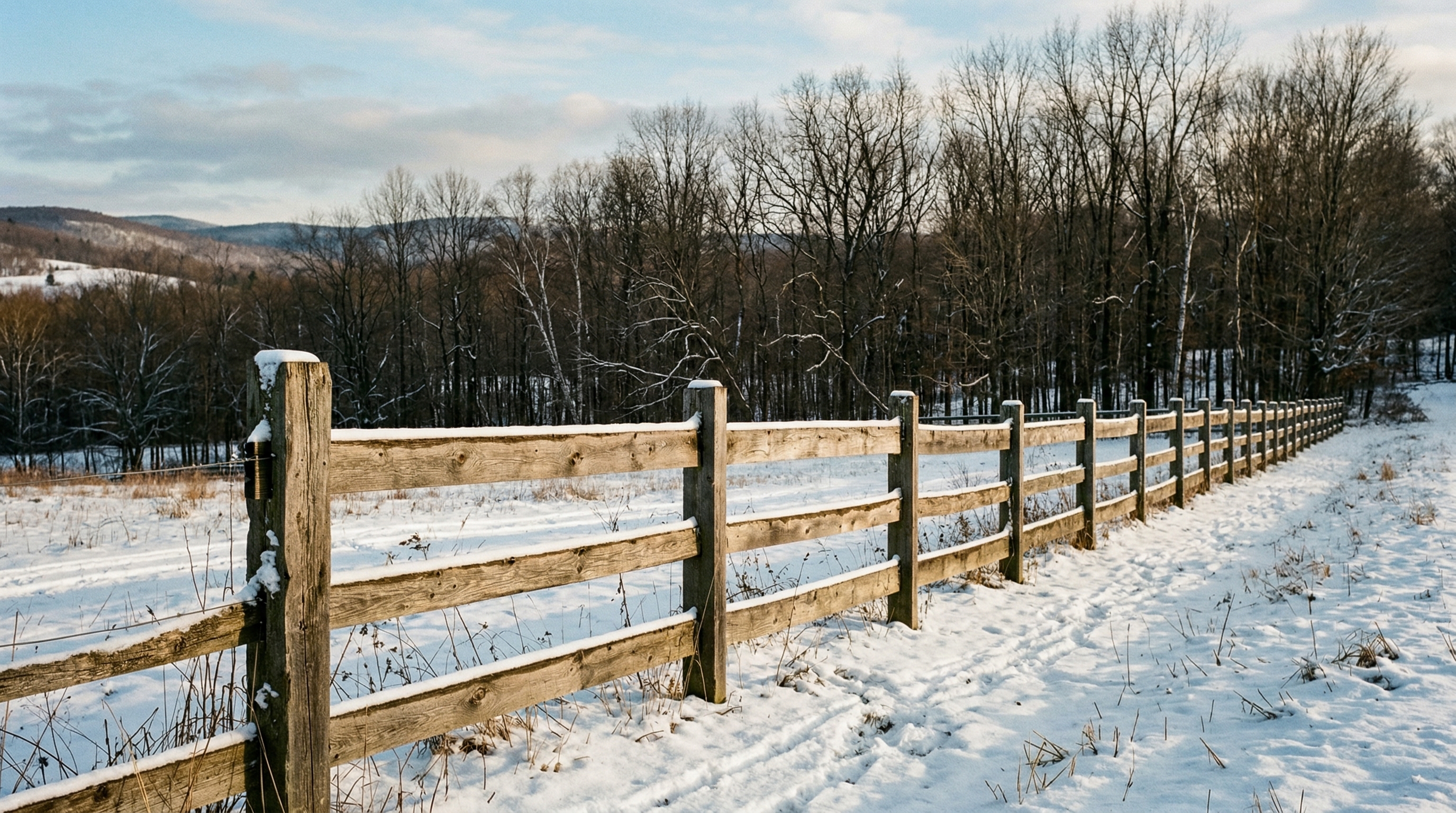
Two calls in one week last November. First one: a cedar privacy fence in Castleton, five years old, leaning hard after a wet snowfall. The posts were rotting at ground level. Second call: a vinyl fence in Rutland Town, eight years old, two panels shattered from a branch that came down in an ice storm. Two different materials, two different failures. Neither one was the material's fault: both were installation problems.
We install both cedar and vinyl. We don't push one over the other because the right answer depends on your property, your budget, and how much time you want to spend on upkeep. Here's the breakdown.
What Does Each Fence Cost Upfront?
For a standard 6-foot privacy fence in Rutland County:
| Item | Cedar | Vinyl |
|---|---|---|
| Material per linear foot | $15 - $25 | $20 - $35 |
| Labor per linear foot | $10 - $18 | $12 - $20 |
| Total installed per linear foot | $25 - $43 | $32 - $55 |
For a typical 150-linear-foot perimeter fence, that's roughly $3,750-$6,450 in cedar or $4,800-$8,250 in vinyl. Cedar wins on day-one cost. But that's only half the story.
What About Long-Term Costs?
Cedar needs maintenance. Period. If you don't stain or seal it within the first year, it starts graying. That silvery weathered look is fine if that's what you're going for, but it also means the wood is drying out and becoming more vulnerable to rot and splitting.
A proper stain job on 150 feet of privacy fence runs $500-$800 in materials if you DIY, or $1,200-$2,000 if you hire it out. You need to do that every two to three years. Over a 20-year lifespan, you're adding $4,000-$15,000 in maintenance depending on whether you do it yourself.
Vinyl needs a hose-down once a year. That's it. No staining, no sealing, no replacing warped boards. The upfront premium pays for itself within seven to ten years on maintenance savings alone.
How Does Each Handle Vermont Snow and Wind?
Snow load: This is where cedar has an edge. A heavy wet snowdrift leaning against a cedar fence flexes the boards but usually doesn't break them. Wood bends. Vinyl is rigid: it either holds or it cracks. We've replaced more vinyl panels after heavy snow years than cedar boards. That said, proper post spacing (6 feet on center instead of 8) and horizontal rails top and bottom help vinyl handle the load.
Wind resistance: Privacy fences act like sails. In exposed areas (hilltops, open fields) wind is a bigger concern than snow. Cedar can rack and lean over time if the posts aren't deep enough and braced properly. Vinyl stays plumb longer because the panels lock into the posts, but if a gust catches a panel wrong, it can pop out of the channel entirely.
For properties with a lot of wind exposure, and we have plenty in Rutland County, we sometimes recommend a semi-privacy design with small gaps between boards. Cuts wind load by 30-40% and the fence lasts years longer.
What Do Vermont Building Codes Require?
Fencing regulations vary by town in Vermont. Most towns in Rutland County don't require a permit for fences under 6 feet unless you're in a flood zone or within a certain distance of a road. But a few requirements apply everywhere:
- Post depth must meet frost line requirements: 48 inches minimum in most of Rutland County
- Setback from property lines: typically 2 feet, but check your town zoning
- Height limits: usually 6 feet for backyard, 4 feet for front yard
- The "good side" faces your neighbor (the finished side faces out)
We pull permits when required and handle the zoning check before every job. Nobody wants to tear down a fence they just paid for because it's six inches over the property line.
How Do They Look Over Time?
Cedar starts out warm and golden. Beautiful wood. Within a year without stain, it fades to silver-gray. Within five years, untreated cedar starts showing cracks, splits, and the occasional warped board. Well-maintained cedar keeps its character and darkens into a rich tone that vinyl can't replicate.
Vinyl starts white, tan, or gray and stays exactly that color. Ten years later, it looks the same. Some people love that consistency. Others find it sterile: it's a plastic fence and it looks like one. The wood-grain textured vinyl products have gotten better, but up close you can always tell.
So Which Should You Pick?
Go cedar if:
- You want a natural look that fits Vermont's rural landscape
- You're willing to stain every 2-3 years (or like the weathered look)
- Budget is tight upfront
- You have heavy snow load areas where flexibility matters
Go vinyl if:
- You never want to think about fence maintenance
- You're planning to sell the property within 5-10 years
- You want a clean, uniform look
- Long-term cost matters more than upfront price
We install about 60% cedar, 40% vinyl across our fence jobs. The split has been moving toward vinyl in recent years, mostly because people are tired of the maintenance commitment. Either one will serve you well if it's installed right: deep posts, proper spacing, good hardware. That's the part that actually determines whether your fence is standing straight in year ten. For exactly how deep those posts have to go and what size and spacing a 6-foot fence needs in Rutland County, see our guide to fence post depth and the Vermont frost-line rule. And if you are weighing that material choice against the price, our breakdown of what a fence costs in Vermont per linear foot puts real ranges next to each option.