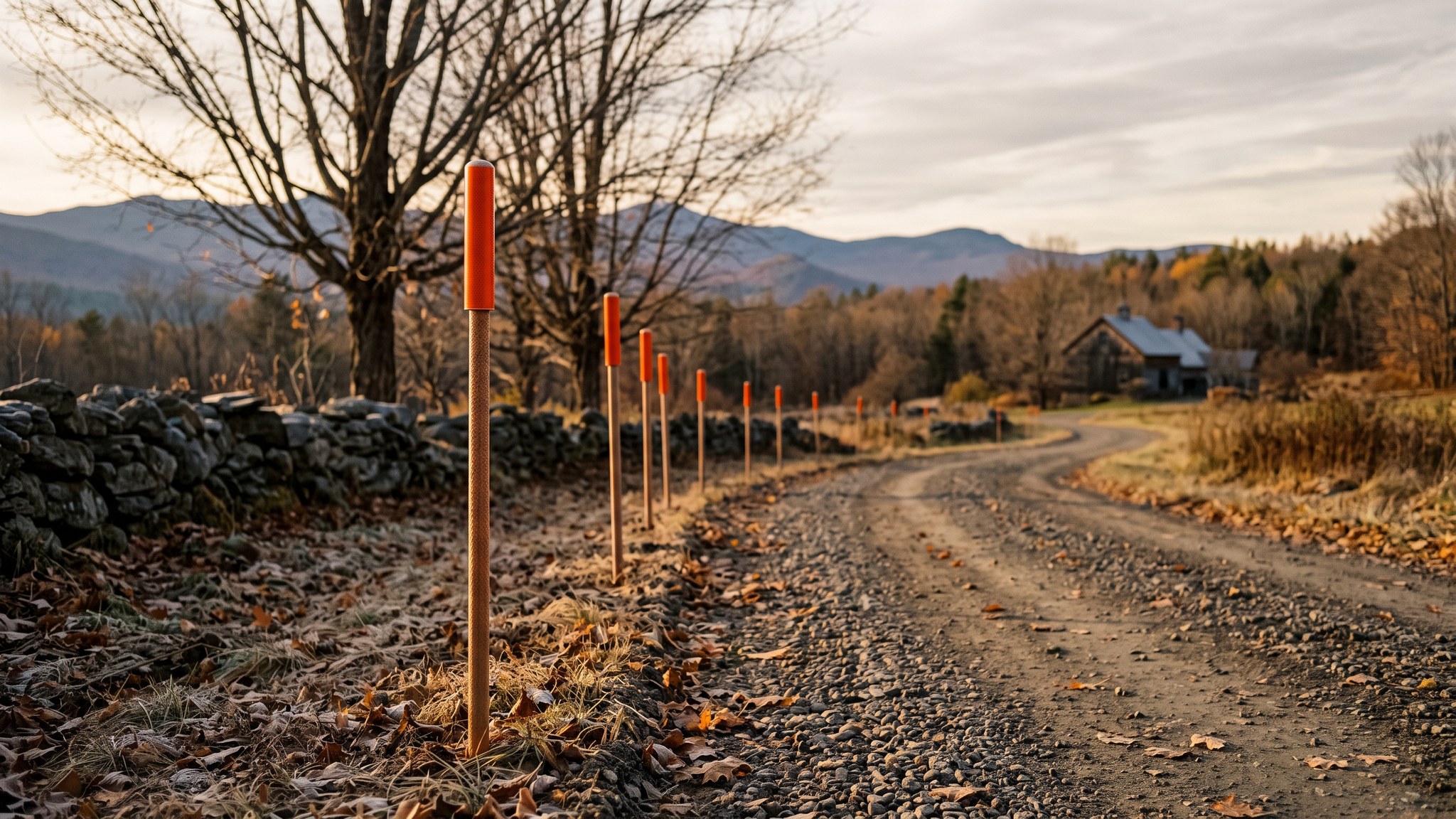
Put your stakes in before the ground freezes, and put them where the plow can hurt you, not just along the pretty part of the driveway. In Rutland County that means late October, because once the top 3 or 4 inches set up you are hammering into concrete and you will snap half of them.
I will tell you why I care about this more than most of what we do in the fall. Every spring we reseed somebody's lawn edge because nobody could tell in January where the driveway stopped. It is the same repair every year on properties that never got marked, and it is one of the few jobs where I know the cause before I get out of the truck. Ten dollars of stakes in October is the whole fix.
What a Driver Can Actually See in January
After the third or fourth storm, your property is one continuous white surface. The driveway, the lawn, the ditch and the flower bed are all the same height and the same color. The banks from the last plow have buried whatever edge was still visible, and if it is snowing during the push, the headlights just bounce back.
Drivers go off memory and off whatever is standing above the snow. On a property we have plowed for years, memory carries most of it. On a new property, or after a storm that drops a foot overnight, memory is not enough. The stakes are the only thing telling the driver where the gravel ends.
This matters more on gravel than on pavement. A paved edge gives the blade something to ride. Gravel has no edge at all once it is covered, and the plow will take the shoulder with it if the driver guesses wrong by a foot.
Where the Stakes Go
Most people stake the straight run and stop. The straight run is the part least likely to cause trouble. Mark these instead:
- Both sides of the entrance off the town road, where the banks get highest and the sightline is worst.
- Culvert ends. A plow that clips a culvert end bends it, and you find out in April when the water backs up and takes the driveway apart.
- The turnaround or hammerhead. This is where a driver has to swing wide, and it is where lawn gets scalped.
- Septic lids and the leach field edge. A riser lid catches a blade beautifully. Mark it even if it never gets driven on, so nobody stacks snow there.
- Anything low and solid you would not want hit: granite curbing, the water shutoff, landscape boulders, the corner of a retaining wall.
- The spot where snow can go, and the spot where it cannot. Marking the pile area saves an argument in February.
Skip the middle of a long straight stretch if you want to save stakes. Nobody has ever damaged anything there.
How Tall and How Far Apart
Use stakes that stand at least 4 feet above grade. 5 feet is better on a road-facing entrance. Our snowpack plus the bank a plow throws will bury a 3 foot stake by February, and a stake you cannot see is the same as no stake.
Space them roughly every 15 to 20 feet on the open runs, and tighten that up to every 8 to 10 feet through curves, at the entrance and anywhere the edge does something unexpected. Reflective tops are worth the small upcharge because most of our plowing happens in the dark on both ends of the day.
Fiberglass rods last several seasons and flex instead of snapping. Wooden lath is cheaper and fine for one winter, but it splinters and you will be picking it out of the lawn in spring. Set each one a good 8 to 10 inches deep so frost does not heave it out in a January thaw.
What Gets Damaged, and Who Pays
Here is the honest part, because it is the question underneath the question. On an unmarked property, the common damage is lawn edge torn up along the driveway shoulder, a bent culvert end, a cracked septic riser, and gravel dragged 20 feet into the grass. None of it is dramatic. All of it costs real money to put back in the spring.
Most plowing agreements, ours included, cover damage caused by driver error but not damage to things that were never marked and could not reasonably be seen. That is standard and it is fair, but people are surprised by it in April. If your septic lid sits 4 inches proud in the middle of a turnaround and nothing flags it, that is not a driver error. Read whatever you sign, and ask specifically how unmarked obstacles are handled. Our own breakdown of what is included in snow removal in Vermont covers the rest of the scope.
When it does go wrong, spring repair is the reseeding pass I mentioned. We wrote up how we fix snowplow damage to a lawn in May, and every one of those jobs started with an edge nobody could see.
The Rest of the Pre-Storm Walk
While you have the stakes out, walk the property once with winter in mind:
- Swing every gate fully open and decide if it stays open all winter. A gate that opens into the plow path is a problem in the first storm.
- Look up. Branches that clear a truck in September do not clear it loaded with ice in February.
- Pull hoses, shut the outside spigots, and get the downspout extensions out of the plow path.
- Move anything seasonal off the edges. Planters, hoses, the grill, the decorative rock somebody put at the driveway mouth.
- Decide where the snow goes now, while you can see the ground, and make sure that spot does not drain back across the driveway during a thaw.
Most of that overlaps with a normal winter property prep pass, so it is not extra work if you are already doing the fall cleanup.
Do It in October
The ground in Rutland County is workable through most of October and gets unreliable after that. By mid November you are picking at frozen crust in the mornings, and by December you are not getting a stake in at all without a bar and a lot of patience.
So this is a short window, and it closes quietly. If you are booking plowing for the season anyway, do the walk at the same time. We generally set stakes as part of the pre-season visit for properties we plow, and for second homes we mark it before the owners come up, because the owner is rarely here when the first storm lands.
If you want us to handle the season, book it before the calendar fills or just tell us what you need and we will come walk it with you.