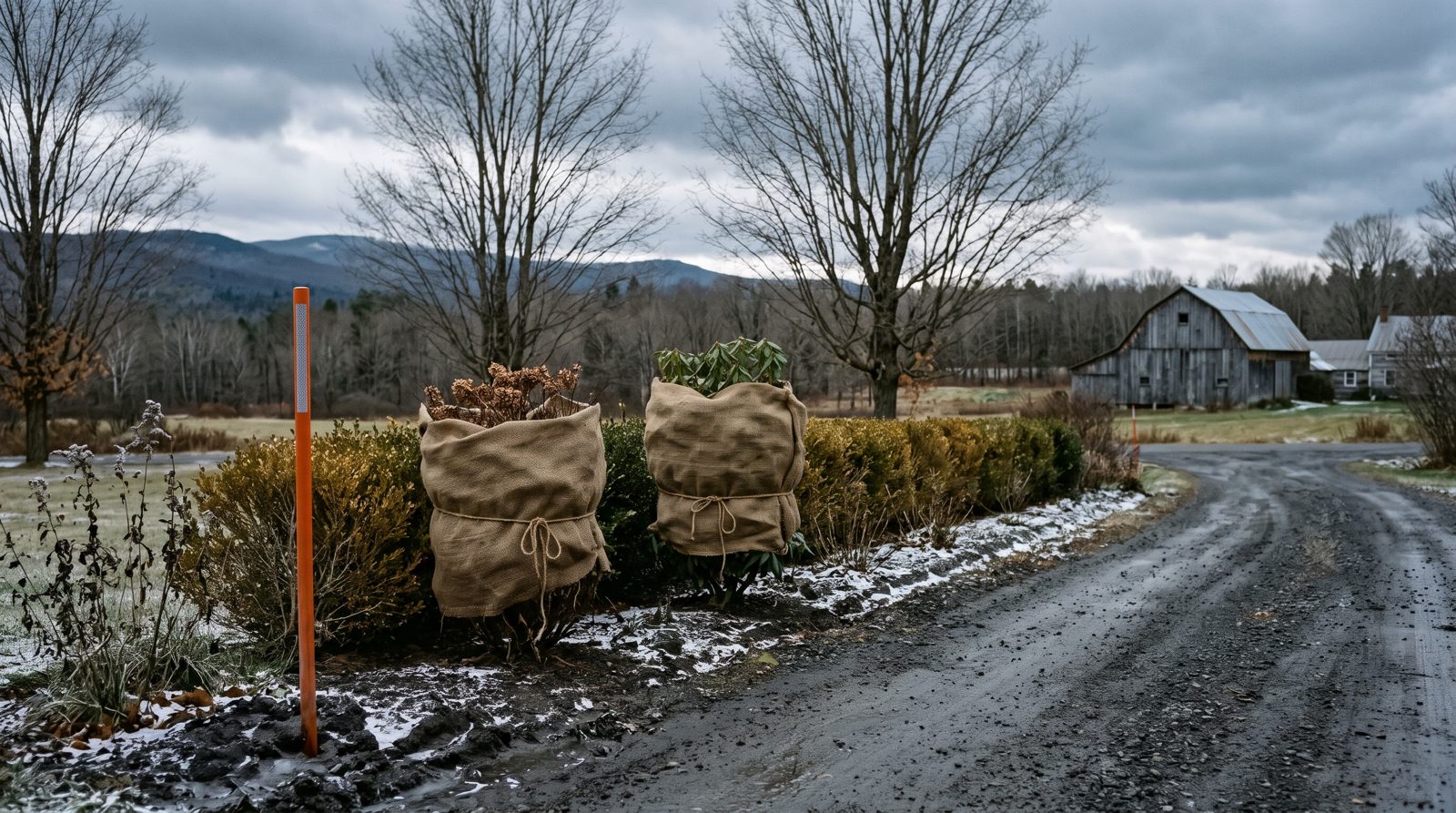
You can still protect shrubs from snow and ice this week. In most of Rutland County the real deadline is not the first snow, it is the first hard freeze, because burlap and twine are useless without a stake and a stake is useless once the top 3 or 4 inches of ground sets up. At valley elevation that gives you the last week of October most years. Up toward Mendon and the Killington access road, assume you have already lost a few days.
Updated October 2026.
We get asked this every year in the same week, usually by somebody who just looked out the kitchen window and noticed the yews are still bare. The short answer is that you have time, and that the half hour you spend on four plants matters more than a full afternoon spent on twenty.
What actually breaks a shrub up here
Three things do almost all of the damage on the properties we maintain, and only one of them is cold.
The first is weight. Wet snow loads the top of an upright evergreen, the branches splay outward, and once they splay they stay splayed. An arborvitae that opened up in February does not close back up in May. The second is load from above, which is its own problem and the one people never see coming. A standing-seam metal roof holds snow until it does not, and then it drops a slab onto whatever is planted under the eave. We replace more foundation plants killed by their own roof than by any plow.
The third is salt, and it is slower and sneakier. Road salt and driveway salt come off the pavement as spray, land on the road-facing side of a plant, and show up the following June as brown needles on one side and healthy growth on the other. One-sided dieback on the side facing the road is almost never a disease. It is the sander.
What to wrap, and what to leave alone
Wrap the things that cannot recover from being bent. Upright arborvitae, columnar yews, anything narrow and tall. A spiral of jute twine from the base up, snug enough to hold the form and loose enough that you are not strangling it, does more than any amount of burlap. If you only do one thing this week, tie up the uprights.
Burlap is for the salt problem, not the snow problem. A burlap screen staked on the road side of a bed stops the spray without trapping heat against the foliage. It should stand a few inches clear of the plant rather than be wound around it like a bandage. Wrapping foliage tight is how you get a plant that bakes on the first sunny day in March and comes out of winter looking worse than the one you left alone.
Leave alone: deciduous shrubs that are already bare, anything broad and low that the snow simply covers, hydrangeas, lilacs, spirea. Snow is insulation for those. The exception is a shrub sitting directly under a metal roof eave, in which case the question is not what you wrap it in, it is whether anything should be planted there at all.
The plow line is a conversation, not a guess
The beds that get hit are predictable. They are the ones inside the arc where a truck swings around, and the ones at the entrance where the banks pile up highest by January. If you are already putting in driveway markers, and you should be, mark the bed corners in the same pass. A stake standing 4 feet above grade at the corner of a bed tells a driver at two in the morning what the snow has hidden, and it costs about what a coffee costs.
Tell us where the snow is allowed to go, too. A bank of pushed snow is heavier than anything that falls out of the sky, and a bed used as a snow pile for one winter is a bed that gets rebuilt in the spring. We would rather have that conversation in October than settle it in April, and we ask about it on every property we take on.
How late is too late
Twine goes on any time. You can tie up an arborvitae in a snow squall if you have gloves on, and if the branches are already loaded, knock the snow off with an upward sweep of a broom before you tie. Never beat frozen branches downward. They snap.
Stakes and burlap screens need unfrozen ground, so that is the part with a real deadline, and this is the week. Anything that needs digging, moving a plant out from under an eave, amending a bed, is a spring job now. Write it down and we will pick it up in the mud season walk-through.
If something already got crushed last winter and you left it, do not prune it now. Broken wood is ugly and it is also what is holding the rest of the plant upright through another season. Cut it in spring once you can see what actually leafed out.
Most of the work we do in the fall is about knowing where the edges are before everything turns white. The same logic that puts markers along the driveway puts a stake at the corner of a bed, and the reason we care is sitting in the reseeding we do every May on properties that were never marked. If you want the rest of the list, the winter prep walk-through covers the buildings and the water side of it.
Call us if you are not sure which of your plants are the uprights worth tying. It is a two minute answer on the phone and it saves a plant that takes six years to replace.