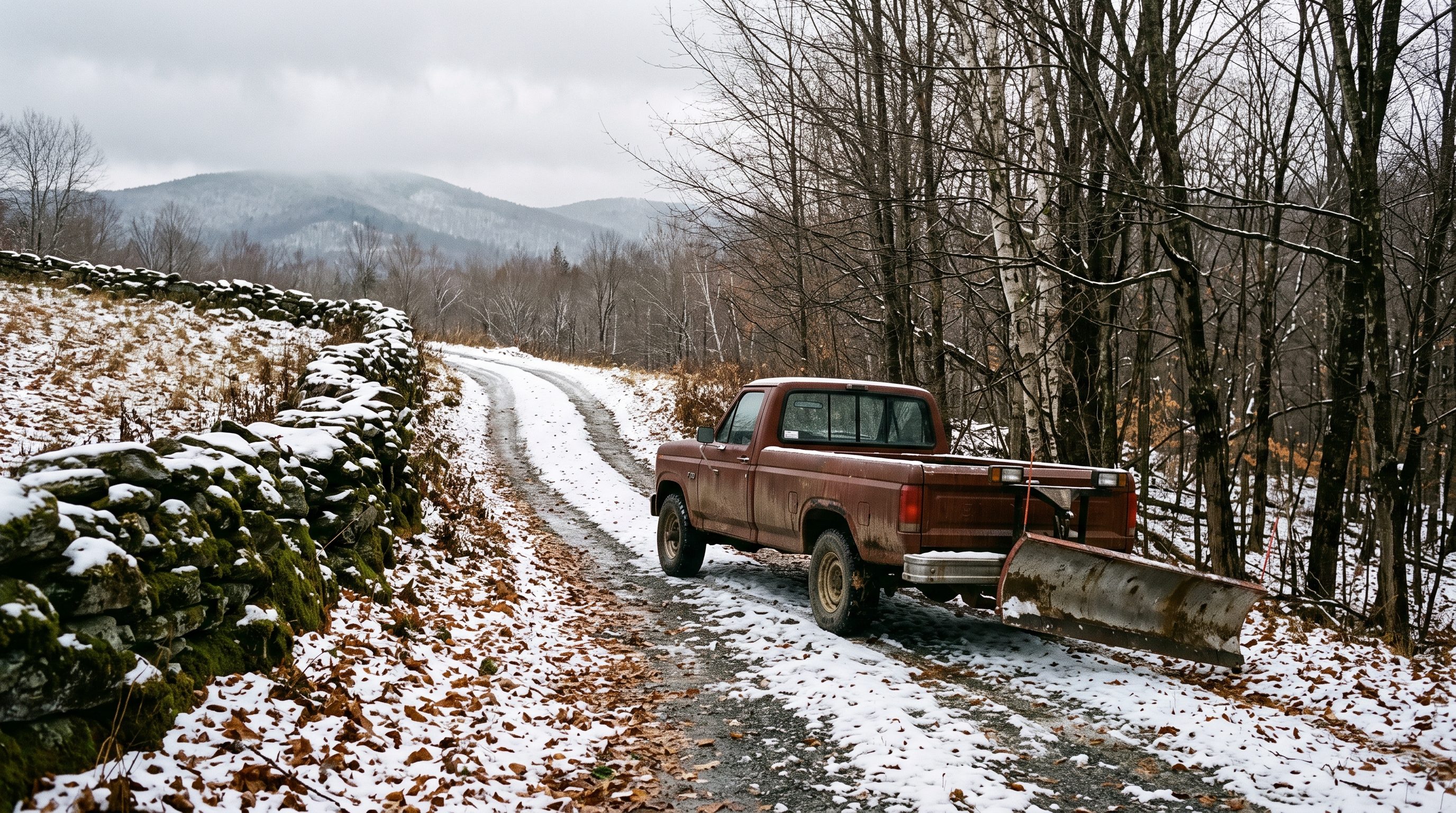
If your driveway has less than about 10 feet of clear width, a full size truck with an 8 foot blade is not getting up it without taking something with it. That is the short answer, and we would rather give it to you in October than in January. The useful version is longer, because clear width is not the same as the width you measured, and most of the driveways we turn down on paper turn out to be fine once we walk them.
We get this call every fall, and it comes in two flavors. One is somebody who just bought a place and has never had it plowed. The other is a second home owner who has been handling it themselves with a snowblower and has reached the point where they are not here enough for that to work. The second group is who we want to talk to first, because the answer for them is different.
What actually has to fit
A three quarter ton pickup is a little under 7 feet across the body and closer to 8 with the mirrors out. The plow is wider than the truck on purpose, usually 7.5 or 8 feet, because the blade has to cover the tire track when it is angled. Angle a blade and it gets narrower across, which is the trick people miss when they measure.
So the real number is not the truck. It is the truck plus the room to turn the blade, plus enough margin that a wet February push does not put a corner into your lawn. 10 feet of clear travel is comfortable. 9 is workable on a straight run. 8 and under, we are going to want to see it before we say yes to anything.
Clear is the word doing the work in that sentence. Not the gravel width. The width between the things that do not move.
Measure the pinch point, not the driveway
Walk the drive with a tape and find the narrowest spot. That is your number, and everything else is irrelevant.
The usual culprits around here are stone walls, a pair of maples that were planted when the drive was for a wagon, a culvert headwall at the road, and a propane tank somebody set three feet off the edge. Then there is the part nobody thinks of, which is the overhead. A low branch at 9 feet is a real constraint, because a plow truck with a sander in the bed is taller than your car and the branch is going to be carrying snow load when it matters.
Measure the entrance separately. The apron where the drive meets the road is where the truck has to swing in off a town road that has already been plowed, which means there is a bank there by January that is not there in October. A 12 foot entrance in the fall can be a 9 foot entrance after three storms.
And look at the turnaround. If there is nowhere to turn, the truck has to back the whole length, and backing a plow down a curved Vermont driveway in the dark is how mailboxes die.
Where does the snow go
This one surprises people more than the width does, and it has ended more conversations than clearance ever has.
A plow does not remove snow. It relocates it. Every push needs somewhere downhill or downwind to put the pile, and if your driveway is cut into a bank on both sides, by the third storm there is nowhere left and the usable width starts shrinking toward the middle. We have plowed drives in Mendon where February width was two thirds of October width, purely from stacking.
So when we walk a property we are looking for the dump spots as much as the pinch points. A corner of lawn that can take a pile. A downhill shoulder. Somewhere that is not the septic mound, not the propane tank, and not on top of the heat pump. If there is genuinely nowhere, the honest answer is that the drive needs a blower or a tractor with a bucket rather than a truck, and sometimes it needs to be trucked out entirely in a bad year.
When a truck is the wrong tool
Plenty of driveways in Rutland County should not see a plow truck, and saying so has never cost us a customer we wanted.
A narrow drive with a hard pinch, a steep pitch with a turn at the bottom, a paver or stamped concrete apron, a drive that crosses a soft shoulder that never really firms up: those get a smaller machine. A compact tractor with a blower throws the snow rather than stacking it, which solves the nowhere to put it problem outright, and it will go places the truck has no business being. It is slower, so it costs differently, and it goes on a different part of the route.
The other wrong tool is the one you already own. A snowblower is a fine machine if you are standing in the driveway when it stops snowing. If you travel for work, that machine is a thing in your garage that makes you feel prepared while your driveway fills in.
Who pays when the edge gets clipped
Ask this before you sign with anybody, including us.
Stakes are the answer, and they go in before the ground freezes, which in Rutland County means October and not the first week of December when you remember. Marked edges are what let a driver push to the actual edge in the dark with 18 inches down and no visible reference. We wrote the whole staking method up in staking your driveway before the first storm, including spacing and height, because a stake every 40 feet is decoration.
Our position is plain. If the edge was marked and we clip it, that is ours to fix in the spring. If it was not marked and we guessed, we are both finding out in April. Culverts and septic risers get flagged separately and specifically, because a culvert headwall does not bend.
The site visit is the whole answer
We will not tell you over the phone that a truck fits your driveway. Not because we are being difficult, but because the tape measure does not capture the turn, the pitch, the bank at the road or the place the snow has to go, and we have been wrong from a description before.
The visit takes about 15 minutes and it happens before the first storm, not after. It is the same visit that sets the stakes, so if you are booking fall cleanup this month we can do the whole thing in one stop and have the property on the route before anything falls. For a second home that nobody is standing in, that visit is also when we agree how you find out it was done, which matters more than it sounds when you are 300 miles away and the forecast says a foot.
If you are weighing the structure of the agreement itself, what is included in snow removal covers scope, and our snow and ice management page has both billing structures. For an owner who is not here much, opening a Vermont second home is the other half of the same year.